
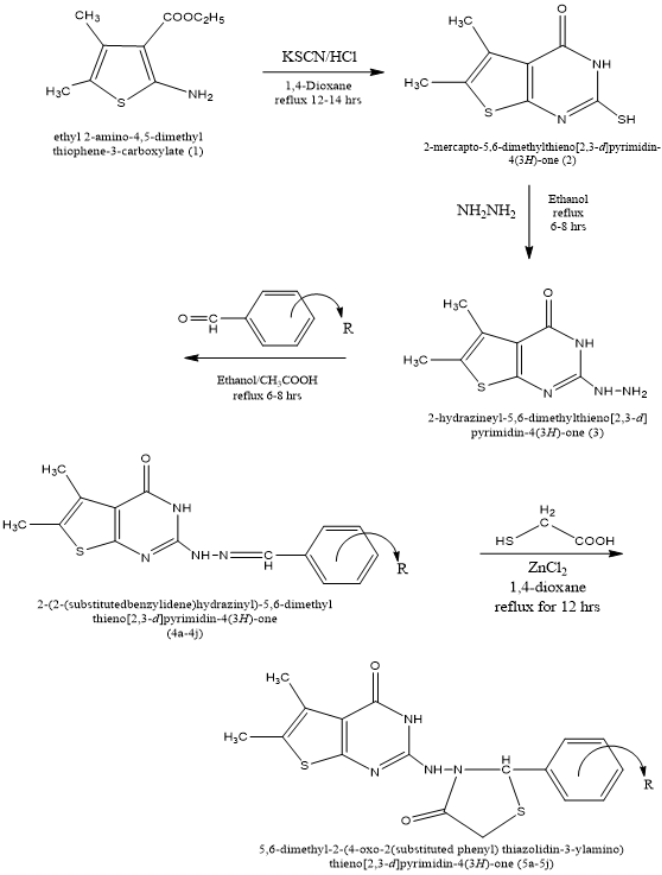
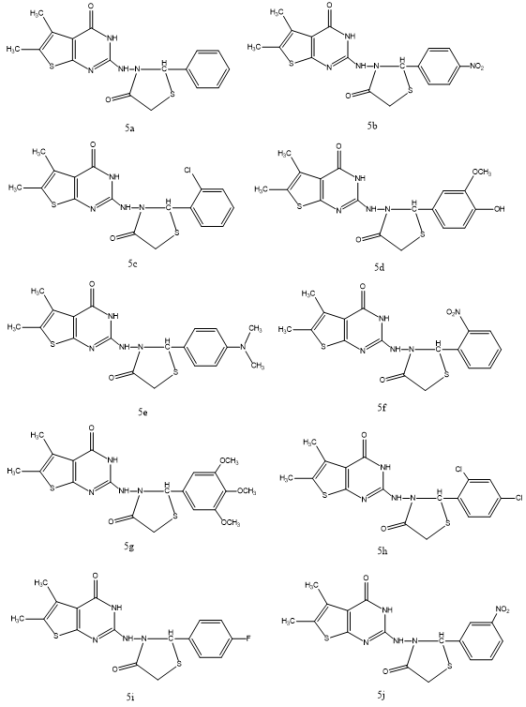
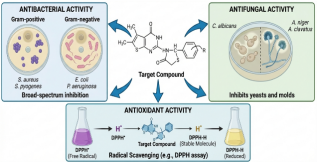
A new set of 5,6-dimethyl-2-(4-oxo-2-(substitutedphenyl)thiazolidin-3-ylamino)thieno[2,3-d]pyrimidin-4(3H)-one compounds (5a-5j) was successfully synthesized using a rational multi-step synthetic strategy starting from ethyl-2-amino-4,5- dimethylthiophene-3-carboxylate. The synthetic route started with the formation of the thienopyrimidinone scaffold, followed by hydrazinolysis to give the corresponding hydrazine intermediate. The Schiff base reaction with various substituted aromatic aldehydes gave the key imine intermediates, which underwent cyclocondensation with thioglycolic acid to give the desired thiazolidinone hybrids. The protocol used proved efficient, as the desired compounds were obtained in good to excellent yields. All the newly synthesized compounds were fully characterized using elemental analysis and various spectroscopic techniques, including IR, 1H NMR, 13C NMR, and mass spectrometry, thus confirming the proposed molecular structures. The characteristic spectral data provided evidence for the successful incorporation of both the thienopyrimidine and thiazolidinone pharmacophores. The synthesized compounds were tested for their multi-target biological properties, including antibacterial, antifungal, and antioxidant activities. Antibacterial activity was tested against representative Gram-positive (Staphylococcus aureus, Streptococcus pyogenes) and Gram-negative (Escherichia coli, Pseudomonas aeruginosa) bacteria, while antifungal activity was tested against Candida albicans, Aspergillus niger, and Aspergillus clavatus. In addition, antioxidant activity was determined using the 1, 1-diphenyl-2-picrylhydrazyl (DPPH) free radical scavenging assay. Several compounds showed significant antimicrobial activity, especially those with electron-withdrawing substituents, indicating enhanced interaction with microbial targets. However, compounds with electron-donating substituents showed better antioxidant activity, indicating favorable radical scavenging capacity. The results suggest that thienopyrimidine–thiazolidinone hybrids constitute a promising class of multifunctional heterocycles, meriting further investigation for potential therapeutic applications.
| Published in | American Journal of Heterocyclic Chemistry (Volume 11, Issue 1) |
| DOI | 10.11648/j.ajhc.20261101.11 |
| Page(s) | 1-10 |
| Creative Commons |
This is an Open Access article, distributed under the terms of the Creative Commons Attribution 4.0 International License (http://creativecommons.org/licenses/by/4.0/), which permits unrestricted use, distribution and reproduction in any medium or format, provided the original work is properly cited. |
| Copyright |
Copyright © The Author(s), 2026. Published by Science Publishing Group |
Thieno[2, 3-d]Pyrimidine, Thiazolidinone, Antibacterial Activity, Antifungal Activity, Antioxidant Activity
Compounds | Minimal Inhibition Concentration (µg/mL) | |||
|---|---|---|---|---|
Gram +ve | Gram -ve | |||
S. aureus | S. pyogenes | E. coli | P. aeruginosa | |
5a | 62.5 | 62.5 | 125 | 250 |
5b | 31.25 | 31.25 | 62.5 | 125 |
5c | 31.25 | 62.5 | 62.5 | 125 |
5d | 62.5 | 62.5 | 125 | 250 |
5e | 31.25 | 31.25 | 62.5 | 125 |
5f | 31.25 | 31.25 | 62.5 | 125 |
5g | 62.5 | 62.5 | 125 | 250 |
5h | 15.62 | 31.25 | 31.25 | 62.5 |
5i | 31.25 | 31.25 | 62.5 | 125 |
5j | 31.25 | 31.25 | 62.5 | 125 |
Ampicillin | 10 | 10 | 25 | 50 |
Chloramphenicol | 12.5 | 12.5 | 12.5 | 25 |
Ciprofloxacin | 6.25 | 6.25 | 6.25 | 12.5 |
Compounds | Minimal Fungicidal Concentration (µg/mL) | ||
|---|---|---|---|
C. albicans | A. niger | A. clavatus | |
5a | 125 | 250 | 250 |
5b | 62.5 | 125 | 125 |
5c | 62.5 | 125 | 125 |
5d | 125 | 250 | 250 |
5e | 62.5 | 125 | 125 |
5f | 62.5 | 125 | 125 |
5g | 125 | 250 | 250 |
5h | 31.25 | 62.5 | 62.5 |
5i | 62.5 | 125 | 125 |
5j | 62.5 | 125 | 125 |
Nystatin | 10 | 20 | 20 |
Greseofulvin | 25 | 50 | 50 |
Compounds | IC₅₀ (µg/mL) |
|---|---|
5a | 78.5 |
5b | 65.2 |
5c | 70.8 |
5d | 32.4 |
5e | 48.6 |
5f | 60.3 |
5g | 28.9 |
5h | 58.7 |
5i | 54.2 |
5j | 62.8 |
Ascorbic acid | 21.5 |
BHT | 26.3 |
M. F. | Molecular Formula |
M. P. | Melting Point |
TLC | Thin Layer Chromatography |
UV | Ultra Violet |
IR | Infrared |
NMR | Nuclear Magnetic Resonance |
MHz | Megahertz |
DMSO | Dimethyl Suphoxide |
LC-MS/MS | Liquid Chromatography-tandem Mass Spectrometry |
TMS | Tetramethylsilane |
MIC | Minimal Inhibition Concentration |
MFC | Minimal Fungicidal Concentration |
| [1] | El-Sayed, E. H.; Fadda, A. A. Synthesis and cytotoxic activity of some novel thieno[2,3-d:4,5-d′]dipyrimidine derivatives. Acta Chim. Slov. 2018, 65(4), 853-864. |
| [2] |
Patel, P. S.; Akbari, V. K.; Modi, S. D.; Belim, M. A.; Tailor, R. B.; Patel, H. D.; Dewani, B.; Patel, K. C. Synthesis and biological evaluation of Schiff base involving thieno[2,3-d]pyri midine moiety as antimicrobial agents. Res. J. Life Sci. Bioinform. Pharm. Chem. Sci. 2019, 5(5), 31-41.
http://www.rjlbpcs.com/article-pdf-downloads/2019/30/691.pdf |
| [3] | Patel, H. D. Design, synthesis, and characterization of bioactive thieno[2,3-d]pyrimidine derivatives. STAPS 2025, 11(8), 506-519. |
| [4] | Patel, H. D. Synthesis, characterization and antimicrobial evaluation of novel thieno[2, 3-d]pyrimidine-based benzamide derivatives. World J. Pharm. Pharm. Sci. 2026, 14(12), 527-552. |
| [5] |
Patel, H. D. Development of novel thienopyrimidine hybrids: synthesis, characterization and multi-target biological evaluation. IOSR J. Appl. Chem. 2026, 19(1), 05-11.
https://www.iosrjournals.org/iosr-jac/papers/vol19-issue1/Ser-1/B1901010511.pdf |
| [6] | Tolba, M. S.; El-Dean, A. M. K.; Ahmed, M.; Hassanien, R.; Farouk, M. Synthesis and antimicrobial activity of some new thienopyrimidine derivatives. Arkivoc 2017, (v), 229–243. |
| [7] | Lagardère, P.; Fersing, C.; Masurier, N.; Lisowski, V. Thienopyrimidine: A promising scaffold to access anti -infective agents. Pharmaceuticals 2022, 15(1), 35. |
| [8] | Mohi El-Deen, E. M.; Abd El-Meguid, E. A.; Karam, E. A.; Nossier, E. S.; Ahmed, M. F. Synthesis and biological evaluation of new pyridothienopyrimidine derivatives as antibacterial agents and Escherichia coli topoisomerase II inhibitors. Antibiotics 2020, 9(10), 695. |
| [9] | Verma, A.; Saraf, S. K. Thiazolidinone: A biologically active scaffold. Eur. J. Med. Chem. 2008, 43(5), 897-905. |
| [10] | Jain, A. K.; Vaidya, A.; Ravichandran, V.; Kashaw, S. K.; Agrawal, R. K. Recent developments and biological activities of thiazolidinone derivatives. Bioorg. Med. Chem. 2010, 18(2), 639-645. |
| [11] | Chopra, N.; Kaur, K.; Kumar, S. Synthesis, molecular docking and antimicrobial evaluation of new tetrahydrobenzothienopyrimidine derivatives. J. Pharm. Chem. Sci. 2018, 2(6), 1-8. |
| [12] | Khatri, T. H.; Shah, V. H. Effective microwave synthesis of bioactive thieno [2, 3-d] pyrimidines. J. Chil. Chem. Soc. 2017, 62(1), 3317-3321. |
| [13] |
Tolba, M. S.; Sayed, M.; El-Dean, A. M. K.; Hassanien, R.; Abdel-Raheem, S. A. A.; Ahmed, M. Design, synthesis and antimicrobial screening of some new thienopyrimidines. Org. Commun. 2021, 14(4), 365-376.
https://www.acgpubs.org/files/20211231195248A4-114-OC-2109-2214-SI.pdf |
| [14] | Vyas, A.; Sahu, B.; Pathania, S.; Nandi, N. K.; Chauhan, G.; Asati, V.; Kumar, B. An insight on medicinal attributes of pyrimidine scaffold: An updated review. J. Heterocycl. Chem. 2023, 60(7), 1081-1121. |
| [15] | Balouiri, M.; Sadiki, M.; Ibnsouda, S. K. Methods for in vitro evaluating antimicrobial activity: A review. J. Pharm. Anal. 2016, 6(2), 71-79. |
| [16] | Wiegand, I.; Hilpert, K.; Hancock, R. E. W. Agar and broth dilution methods to determine the minimal inhibitory concentration (MIC) of antimicrobial substances. Nat. Protoc. 2008, 3, 163-175. |
APA Style
Patel, H. (2026). Thienopyrimidine-thiazolidinone Scaffolds: Synthesis, Characterization and Targeting Various Bioactivities. American Journal of Heterocyclic Chemistry, 11(1), 1-10. https://doi.org/10.11648/j.ajhc.20261101.11
ACS Style
Patel, H. Thienopyrimidine-thiazolidinone Scaffolds: Synthesis, Characterization and Targeting Various Bioactivities. Am. J. Heterocycl. Chem. 2026, 11(1), 1-10. doi: 10.11648/j.ajhc.20261101.11
AMA Style
Patel H. Thienopyrimidine-thiazolidinone Scaffolds: Synthesis, Characterization and Targeting Various Bioactivities. Am J Heterocycl Chem. 2026;11(1):1-10. doi: 10.11648/j.ajhc.20261101.11
@article{10.11648/j.ajhc.20261101.11,
  author = {Himanshu Patel},
  title = {Thienopyrimidine-thiazolidinone Scaffolds: Synthesis, Characterization and Targeting Various Bioactivities},
  journal = {American Journal of Heterocyclic Chemistry},
  volume = {11},
  number = {1},
  pages = {1-10},
  doi = {10.11648/j.ajhc.20261101.11},
  url = {https://doi.org/10.11648/j.ajhc.20261101.11},
  eprint = {https://article.sciencepublishinggroup.com/pdf/10.11648.j.ajhc.20261101.11},
  abstract = {A new set of 5,6-dimethyl-2-(4-oxo-2-(substitutedphenyl)thiazolidin-3-ylamino)thieno[2,3-d]pyrimidin-4(3H)-one compounds (5a-5j) was successfully synthesized using a rational multi-step synthetic strategy starting from ethyl-2-amino-4,5- dimethylthiophene-3-carboxylate. The synthetic route started with the formation of the thienopyrimidinone scaffold, followed by hydrazinolysis to give the corresponding hydrazine intermediate. The Schiff base reaction with various substituted aromatic aldehydes gave the key imine intermediates, which underwent cyclocondensation with thioglycolic acid to give the desired thiazolidinone hybrids. The protocol used proved efficient, as the desired compounds were obtained in good to excellent yields. All the newly synthesized compounds were fully characterized using elemental analysis and various spectroscopic techniques, including IR, 1H NMR, 13C NMR, and mass spectrometry, thus confirming the proposed molecular structures. The characteristic spectral data provided evidence for the successful incorporation of both the thienopyrimidine and thiazolidinone pharmacophores. The synthesized compounds were tested for their multi-target biological properties, including antibacterial, antifungal, and antioxidant activities. Antibacterial activity was tested against representative Gram-positive (Staphylococcus aureus, Streptococcus pyogenes) and Gram-negative (Escherichia coli, Pseudomonas aeruginosa) bacteria, while antifungal activity was tested against Candida albicans, Aspergillus niger, and Aspergillus clavatus. In addition, antioxidant activity was determined using the 1, 1-diphenyl-2-picrylhydrazyl (DPPH) free radical scavenging assay. Several compounds showed significant antimicrobial activity, especially those with electron-withdrawing substituents, indicating enhanced interaction with microbial targets. However, compounds with electron-donating substituents showed better antioxidant activity, indicating favorable radical scavenging capacity. The results suggest that thienopyrimidine–thiazolidinone hybrids constitute a promising class of multifunctional heterocycles, meriting further investigation for potential therapeutic applications.},
 year = {2026}
}
TY  - JOUR
T1  - Thienopyrimidine-thiazolidinone Scaffolds: Synthesis, Characterization and Targeting Various Bioactivities
AU  - Himanshu Patel
Y1  - 2026/02/27
PY  - 2026
N1  - https://doi.org/10.11648/j.ajhc.20261101.11
DO  - 10.11648/j.ajhc.20261101.11
T2  - American Journal of Heterocyclic Chemistry
JF  - American Journal of Heterocyclic Chemistry
JO  - American Journal of Heterocyclic Chemistry
SP  - 1
EP  - 10
PB  - Science Publishing Group
SN  - 2575-5722
UR  - https://doi.org/10.11648/j.ajhc.20261101.11
AB  - A new set of 5,6-dimethyl-2-(4-oxo-2-(substitutedphenyl)thiazolidin-3-ylamino)thieno[2,3-d]pyrimidin-4(3H)-one compounds (5a-5j) was successfully synthesized using a rational multi-step synthetic strategy starting from ethyl-2-amino-4,5- dimethylthiophene-3-carboxylate. The synthetic route started with the formation of the thienopyrimidinone scaffold, followed by hydrazinolysis to give the corresponding hydrazine intermediate. The Schiff base reaction with various substituted aromatic aldehydes gave the key imine intermediates, which underwent cyclocondensation with thioglycolic acid to give the desired thiazolidinone hybrids. The protocol used proved efficient, as the desired compounds were obtained in good to excellent yields. All the newly synthesized compounds were fully characterized using elemental analysis and various spectroscopic techniques, including IR, 1H NMR, 13C NMR, and mass spectrometry, thus confirming the proposed molecular structures. The characteristic spectral data provided evidence for the successful incorporation of both the thienopyrimidine and thiazolidinone pharmacophores. The synthesized compounds were tested for their multi-target biological properties, including antibacterial, antifungal, and antioxidant activities. Antibacterial activity was tested against representative Gram-positive (Staphylococcus aureus, Streptococcus pyogenes) and Gram-negative (Escherichia coli, Pseudomonas aeruginosa) bacteria, while antifungal activity was tested against Candida albicans, Aspergillus niger, and Aspergillus clavatus. In addition, antioxidant activity was determined using the 1, 1-diphenyl-2-picrylhydrazyl (DPPH) free radical scavenging assay. Several compounds showed significant antimicrobial activity, especially those with electron-withdrawing substituents, indicating enhanced interaction with microbial targets. However, compounds with electron-donating substituents showed better antioxidant activity, indicating favorable radical scavenging capacity. The results suggest that thienopyrimidine–thiazolidinone hybrids constitute a promising class of multifunctional heterocycles, meriting further investigation for potential therapeutic applications.
VL  - 11
IS  - 1
ER  -
Department of Chemistry, Dr. APJ Abdul Kalam Government College, Silvassa, India




 Share This Article
 Twitter
 Linked In
 Facebook
 Copy
Copy Download